Perimenopause, anxiety & self-doubt at work: What actually helps

Struggling with anxiety or self-doubt at work during perimenopause? Learn practical ways to quiet your inner critic, plus techniques you can use between meetings and before challenging conversations.
There’s one universal experience during perimenopause that women notice but rarely talk about, and it’s something that has come up time and time again in our workshops.
You lose your train of thought during a meeting, you second-guess an email you would have sent without hesitation a year ago, and you feel anxiety creeping in before conversations that never used to faze you.
And then that unwanted narrative starts: “I’m not coping.” “What’s wrong with me?” “I’m not capable.” Does this feel familiar? You’re not alone.
Let’s pause right there. Menopause and perimenopause aren’t personal failings; they're very human responses to a significant period of change. It’s not about throwing the towel in and giving up; it requires new systems and new forms of support.
In this article, we’re joined by MenoMinds co-founder Victoria, who shares a recap of our first Wellbeing Academy session, focusing on self-compassion and mindfulness to support anxiety and self-doubt at work.
We’ll cover:
This isn’t a confidence issue
Many women navigate through perimenopause, wondering why they’ve lost their confidence overnight. They might blame it on burnout, stress, or an inability to work the way they once did. Perimenopause brings its own set of significant changes and shifts that many women often overlook and dismiss initially.
During perimenopause, women will experience hormonal shifts, particularly in estrogen, which plays a key role in how the brain regulates mood, memory, and stress.
As these levels fluctuate, many women will experience:
Increased anxiety
More difficulty concentrating and recalling information
A heightened sense of pressure or overwhelm
At work, this is challenging and can feel embarrassing. Things that once felt manageable are now requiring more effort. Small mistakes feel bigger, and confidence seems to have dwindled. This is the critical point many women forget: you aren’t losing your ability; you are navigating a period of neurological change.
Why anxiety and self-doubt show up at work during menopause
Work is often where the impact of perimenopause is the most visible, and there are three key reasons for this:
1. Cognitive changes are more noticeable
Forgetting a word, losing your train of thought, or needing more time to process information can quickly be misinterpreted as a decline in competence, rather than a normal, temporary symptom of hormonal change.
2. The brain becomes more threat-sensitive
During perimenopause, the brain is more likely to scan for problems or interpret situations negatively. An email can feel loaded. Feedback can feel personal. Pressure can feel amplified.
This is influenced by our natural negativity bias, the brain’s tendency to hold onto and prioritise negative experiences. During this time of hormonal fluctuation, that bias can become more pronounced, making anxious or self-critical thoughts feel stronger and more persistent throughout the day.
3. The expectation to “hold it together” and stay professional
Many women are balancing demanding roles, leadership responsibilities, and personal commitments. There is often an unspoken expectation to continue performing at the same level, without acknowledging what’s changing internally, for fear they may be perceived as unprofessional or incapable.
“What is negativity bias?
Negativity bias is a psychological tendency to focus on negative events, information, or emotions that influence our thoughts and behaviour more strongly than positive ones. Research suggests this evolutionary trait once supported survival by directing attention to threats, but in modern contexts, it can contribute to cognitive distortions. Evidence shows it can affect memory, decision-making, and attention.”
The inner critic gets louder
Alongside anxiety, many women notice a shift in their internal dialogue. The inner critic, the voice that judges, questions, and second-guesses everything, can become more persistent and more convincing.
You might notice or have already noticed thoughts like:
“I should be coping better”
“I’m not as sharp as I used to be”
“Something’s wrong with me”
It’s important to understand that this voice isn’t new. It’s a protective system that’s designed to keep you safe from mistakes, threats, and failure. During perimenopause, it’s in overdrive and will likely feel more noticeable than ever before.
The brain’s threat system is heightened, and the inner critic responds by trying to tighten control. Unfortunately, this often has the opposite effect, fuelling anxiety, increasing self-doubt, and creating a cycle that’s hard to step out of.
Recognising this for what it is, a pattern, not a truth, is a crucial first step.
What actually helps
When anxiety and self-doubt are driven by changes in the brain, pushing harder or “thinking positively” isn’t the solution. What helps is learning to work with your brain differently, being mindful of the changes going on right now and adjusting systems and approaches slowly.
In the Wellbeing Academy session, Victoria focused on three evidence-based approaches that make a meaningful difference, and we’ve summarised them for you below.
Physical changes that don’t always seem connected
1. Mindfulness: creating space from the spiral
Mindfulness is the basic human ability to be fully present, aware of where we are and what we’re doing, and not overly reactive or overwhelmed by what’s going on around us.
Our minds naturally take flight, we lose touch with our body, and pretty soon, we’re engrossed in obsessive thoughts about something that just happened or fretting about the future. That makes us anxious.
Mindfulness is often misunderstood as something abstract or time-consuming. In reality, it’s a practical skill. It’s the ability to notice what’s happening in your mind without immediately reacting to it.
Why practice mindfulness?
Builds neuroplasticity (brain can rewire, change, and adapt more quickly)
Helps you learn new skills more easily
Supports breaking old habits and forming better ones
Improves adaptability to change
Helps with recovering from setbacks
Lets you train the brain deliberately
Improves attention and focus control
Helps you choose your response instead of reacting
Creates space between stimulus and action
Mindfulness brings attention back to the present
Builds psychological distance from thoughts and emotions
Helps you observe thoughts instead of becoming them
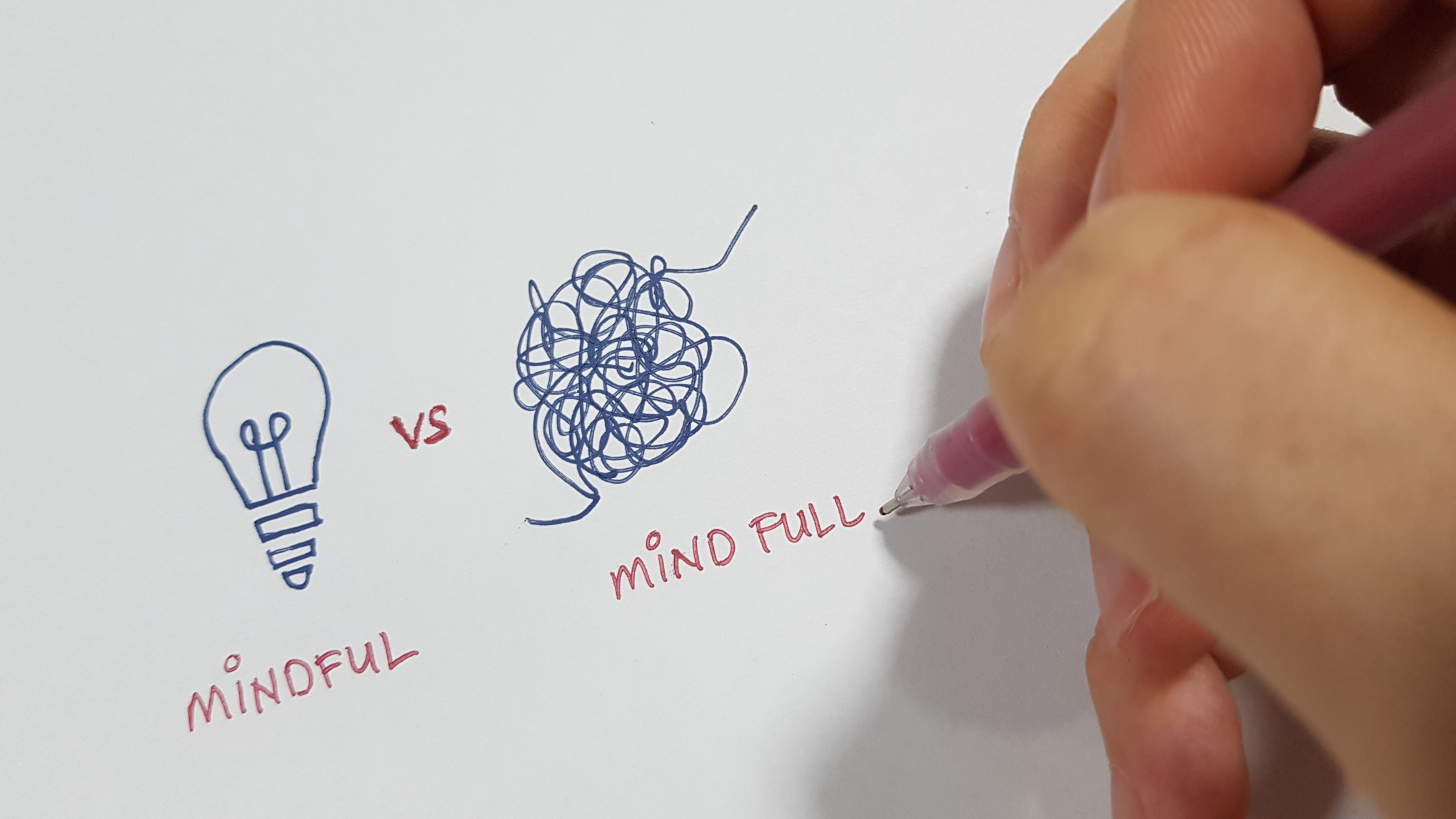
This matters because, during perimenopause, thoughts can quickly escalate:
A small mistake becomes a bigger story that holds you back
A moment of anxiety turns into self-doubt that feels debilitating
Mindfulness interrupts this pattern and stops it in its tracks.
Something as simple as a short breathing practice between meetings can:
Reduce the intensity of anxious thoughts
Improve focus and clarity
Create what we call psychological distance, the ability to step back from thoughts rather than being pulled into them
It’s not about clearing the mind and trying to eliminate every thought you have; it’s about changing your relationship with the thoughts and moving forward.
2. Self-compassion: shifting your internal narrative
"Self-compassion is giving ourselves the same kindness and care we’d give to a good friend." - Dr. Kristin Neff
If you wouldn’t say it to a friend, it may be worth asking why it feels okay to say it to yourself.
For many women, the first response to struggle can be self-criticism. Research suggests that this pattern is associated with higher levels of anxiety and depression, and may also intensify symptoms in conditions like eating disorders, while sometimes straining our relationships with others.
Whereas self-compassion has been linked to lower levels of anxiety and depression, and greater emotional resilience. It can help people relate to themselves with more steadiness, kindness, and understanding, especially during difficult moments.
If you tend to notice a strong inner critic, exploring self-compassion is a no-brainer and can be a meaningful and productive shift, not as a quick fix, but as a different way of relating to yourself over time.
It doesn’t mean lowering standards or letting yourself get away with everything; it means responding to difficulty with the same level of understanding you would offer to someone else.
For example:
Instead of “I’m failing.” > “This is difficult right now, and that makes sense.”
Instead of “I should be coping better.”>“There’s a lot changing, I can support myself through this.”
This shift reduces the intensity of the threat response in the brain and creates a more stable internal environment. Over time, this directly supports confidence, decision-making, and emotional resilience.
When learning about self-compassion, remember these three core elements, as defined by Dr Kristin Neff*. The three core elements of self-compassion are self-kindness, common humanity, and mindfulness.
Self-kindness: Being gentle and supportive toward yourself instead of being harsh or critical when you mess up.
Common humanity: Remembering that everyone struggles and makes mistakes; you’re not alone or “the only one.”
Mindfulness: Noticing your thoughts and feelings without blowing them out of proportion or getting stuck in them.
*Dr Kristin Neff: For the past two decades, she has researched and taught self-compassion and is widely recognised as a pioneering scholar in the academic study of this field.
3. Small, practical resets during the workday
What makes the biggest difference is not one big intervention, but small, realistic, consistent shifts.
For example:
Before a meeting: pause for a few slow breaths and notice how you’re feeling
During a moment of self-doubt: name it… “this is my inner critic”
After a difficult interaction: reflect neutrally, rather than critically
Between tasks: take a 60-second reset instead of pushing straight on
These moments may seem small, but they are how new patterns are formed.
Through neuroplasticity, the brain responds to repetition. Each time you pause, reframe, or respond differently, you begin to weaken old patterns of anxiety and strengthen new helpful ones.
Rethinking confidence during perimenopause
One of the most common concerns we hear is:“I’ve lost my confidence.”
In most cases, the confidence hasn’t disappeared; it has simply become less accessible under increased mental and emotional load. When the brain is busy managing anxiety, self-doubt, and change, it has fewer resources available for clarity, focus, and decisiveness.
As we covered previously, the brain has a natural negativity bias, and it takes consistent practice to shift these automatic patterns. The capability is still there, it’s just harder to access in the same way. This is not regression; it is a period of recalibration.
With the right understanding and tools, it’s possible to rebuild a sense of confidence and internal support through mindfulness and self-compassion.
So remember, whenever anxiety or self-doubt crops up, it’s often your nervous system signalling that it needs a different kind of support.
Learn more tools to navigate perimenopause and menopause
If you’re ready to explore new tools and strategies to help you navigate perimenopause and menopause with confidence, join our next free CPD-accredited Mental Health in Menopause workshop.
Alternatively, come and join one of our Wellbeing Academy workshops. All free, fully-funded, and virtual. Hopefully we’ll see you at the next one!
Important note:
We are not clinicians and cannot diagnose depression or other mental health conditions. If you’re having thoughts of harming yourself, or you feel like you can’t keep yourself safe, seek urgent help. Contact NHS urgent services, your GP, or a crisis service such as SHOUT (text 85258 in the UK). If you’re in immediate danger, call 999.
Seeking support
If symptoms persist, worsen, or begin to feel overwhelming, it is important to seek professional support. Speaking to your GP can be a helpful first step in understanding what you are experiencing and exploring treatment or support options. We also recognise that not all women feel ready to take this step, or may have had previous experiences that make this difficult.
If you ever feel unable to keep yourself safe, or you are experiencing thoughts of self-harm or suicide, please seek urgent help. You can contact your GP, call NHS 111, or reach out to Samaritans on 116 123 (free, 24/7) or jo@samaritans.org. If you are in immediate danger, call 999 or go to your nearest A&E.