The most common breakthroughs women experience in MenoMinds workshops
We reviewed feedback from hundreds of women who had attended a MenoMinds menopause workshop, and we noticed some powerful common themes. Here are the common shifts women consistently experience.
There’s a moment that happens in almost every MenoMinds workshop.
Sometimes it comes during a breakout conversation. Sometimes it arrives when we’re discussing brain fog, burnout, anxiety, or the hundreds of symptoms that can accompany perimenopause and menopause. Sometimes it appears quietly in the live chat box.
It nearly always sounds something like this: "I thought it was just me. I thought I was going crazy."
For many women, that realisation is the beginning of a breakthrough and a long-awaited connection they have been scrambling for.
When we reviewed feedback from hundreds of women who have attended MenoMinds workshops, we noticed the same powerful themes appearing again and again. While every menopause journey is unique, there are some common shifts that women consistently experience.
Here are the breakthroughs we see most often.
Jump to a section:
1. You’re not mad, and you’re definitely not alone
2. Self-compassion starts to replace self-criticism
3. Boundaries stop feeling selfish and feel necessary
4. Small changes suddenly feel impactful
5. Understanding brings relief and control
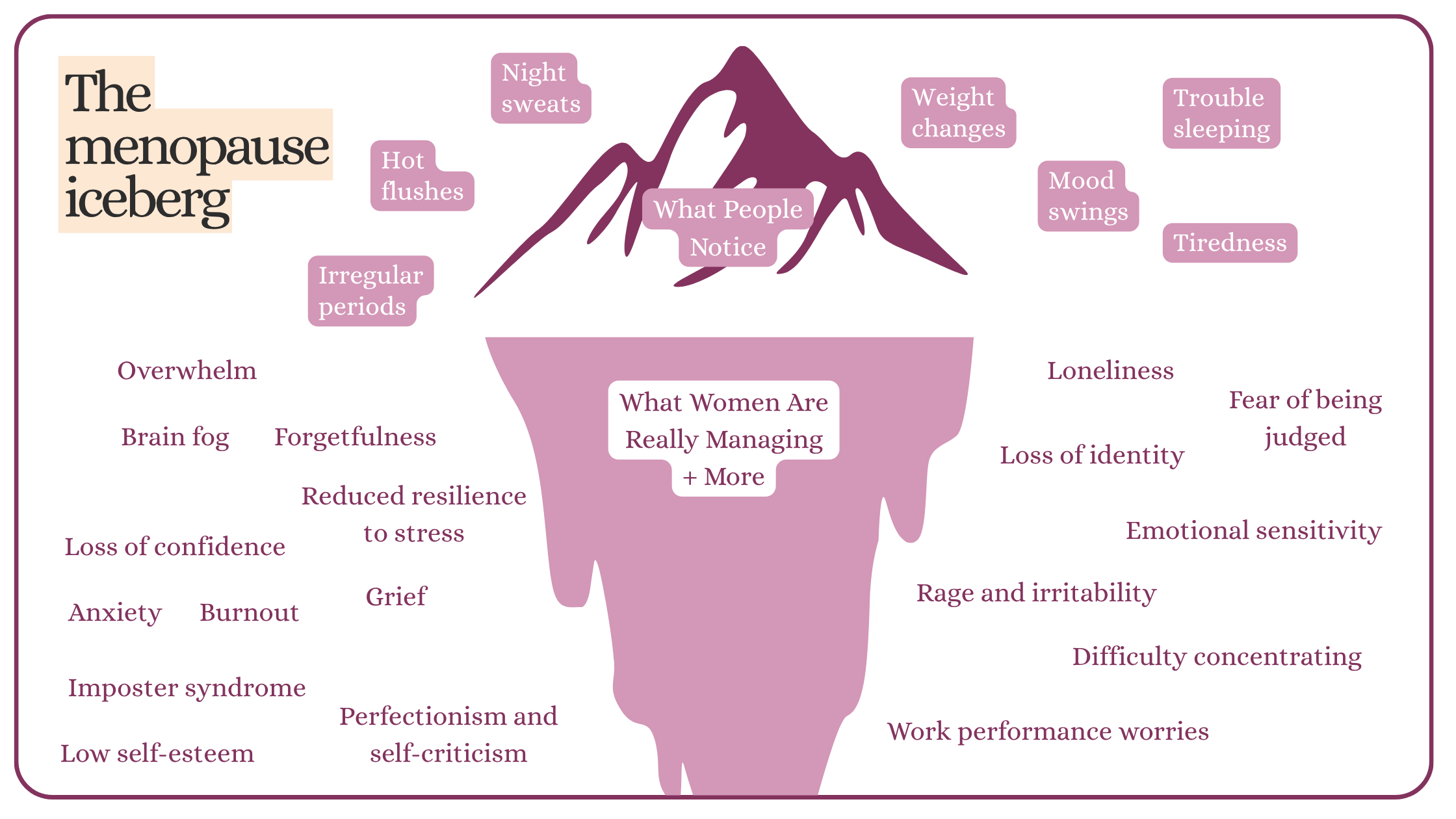
Menopause is like an iceberg
When people think of menopause, they usually think of the symptoms you can see: hot flushes, night sweats, disrupted sleep and changes to periods.
Beneath the surface, though, many women are managing a much larger set of challenges that often go unseen. This is why so many women arrive at MenoMinds looking for information about menopause but leave with something much more meaningful and relevant: validation, connection and a new understanding of what self-compassion really is.
1. You’re not mad, and you’re definitely not alone
This is by far the most common breakthrough. Many women arrive feeling confused by changes in their mood, confidence, concentration, motivation, memory, or emotional resilience. They often wonder whether they're simply failing to cope with life in the way they used to. They sometimes mention that it’s crept up on them without warning, and they feel like they have lost control.
Then they hear other women describing almost identical experiences. Suddenly, the self-doubt starts to lift.
Women frequently tell us that simply hearing others share their stories helps them understand that their symptoms are real, common, and shared by many others navigating this stage of life.
One participant described the experience as: "A real eye-opener... particularly all the emotions and realise that I am not alone on this journey."
Another shared: "To realise that I AM NOT ALONE, I'm not going crazy, I'm not falling apart."
That sense of community often becomes the foundation for everything else, and it’s a big part of what we are aiming to build through our MenoMinds workshops. A community of like-minded women where you can learn, grow, and connect.
2. Self-compassion starts to replace self-criticism
Many women come to us carrying an invisible burden: the belief that they should be coping better and that asking for help is a sign of weakness. They tell themselves they're lazy when they're exhausted and disorganised when they're experiencing brain fog. The workshops help women understand the neurological, hormonal and psychological changes taking place during menopause, and that understanding often creates space for something many haven't offered themselves in years: compassion.
Participants regularly tell us they leave with a renewed commitment to:
Be kinder to themselves
Stop pushing through exhaustion
Accept that their needs have changed
Let go of unrealistic expectations
Speak to themselves as if they were speaking to a friend or loved one
For many women, this shift is profound. Instead of fighting themselves, they start supporting themselves.
If you’re interested in learning more about self-compassion, our co-founder, Victoria, ran a free workshop on the topic of self-compassion and mindfulness. You can access the replay at any time here.
3. Boundaries stop feeling selfish and feel necessary
If there is one practical breakthrough that appears repeatedly in feedback, it's this: Women begin to understand that boundaries are not a luxury or selfish. They're a necessity.
Many participants leave recognising how much of their energy is spent looking after everyone else while neglecting their own needs. They also learn that they are allocating too much energy to the wrong thing, and our workshops bring them much-needed clarity.
We share:
How to say no
How to schedule proper breaks
How to protect your focus
Practical ways to reduce overwhelm
Realistic directions on conserving energy
Women often describe boundaries as a form of self-care rather than selfishness. For some, this is the first time they've permitted themselves to prioritise their wellbeing, and it forms as a celebration, a new way of living, and finally, a new way to claim back their time.
4. Small changes suddenly feel impactful
One of the biggest myths about wellbeing is that change has to be dramatic and has to happen straight away, all in one go. What women often discover in our workshops is that small shifts can have a surprisingly large impact.
Participants frequently mention practical strategies they begin implementing immediately, including:
Taking regular breaks
Using the Pomodoro technique
Mindfulness and breathing exercises
Gratitude practices
Improving sleep habits
Spending more time in nature
Reducing phone distractions
Creating healthier work routines
Reaching out for medical guidance and support
The breakthrough isn't about learning the tools in isolation, it's realising that menopause doesn't have to leave them feeling powerless. There are things they can do, starting today.
We have an array of resources on our website that provide a great starting point, and they are free! You can explore our Resources library right here.

5. Understanding brings relief and control
Knowledge is powerful; we’ve all heard it. But when it comes to your health and mind, it carries a lot more weight. Many women tell us that simply understanding what is happening in their bodies and brains reduces anxiety.
Learning about the connection between hormones, stress, cognition and mental health helps many participants make sense of experiences that previously felt frightening or confusing.
Several women specifically highlighted learning about brain changes during menopause as a turning point. Instead of seeing brain fog, forgetfulness or emotional fluctuations as personal failings, they begin to recognise them as part of a normal transition.
That understanding often replaces fear with confidence.
6. Menopause becomes a conversation, not something to hide
Another common breakthrough is finding the confidence to talk openly about menopause. Many participants arrive feeling isolated or reluctant to discuss their experiences. Some women feel so terrified of speaking up or asking for help that they suffer in silence for too long and struggle through work and home life.
By the end of the workshop, they're often planning conversations with:
Friends
Colleagues
Family members
Managers
Healthcare professionals
Some leave determined to advocate for greater awareness in their workplace or community.
Others simply feel able to ask for support for the first time. Either way, silence starts to lose its grip and meaningful conversations begin to happen.
7. Hope returns, at long last
Perhaps the most important breakthrough of all is hope, but not in a fluffy, non-meaningful way.
Many women arrive feeling exhausted, overwhelmed, disconnected from themselves, or worried that things will never improve. They are looking for a sign, some support, and maybe some answers.
They leave understanding that while menopause can be challenging, it is also a transition, not an ending. A time that can bring greater self-awareness, stronger boundaries, deeper self-care, and a renewed sense of purpose.
As one participant beautifully described: "It will be helpful from this point on to focus on the journey and tackle each challenge without the weight of worry. It's all part of our ongoing flourishing as women."
Come and join a MenoMinds workshop
The workshops provide evidence-based information, practical tools, and expert guidance. If we're really honest, though, the real magic happens when women realise they don't have to navigate this chapter alone.
When they see themselves reflected in other women's stories.
When they feel heard.
When they feel understood.
When they stop asking, "What's wrong with me?" and start asking, "What do I need?"
That's where the breakthroughs begin, and women can begin to take control of their own menopause and perimenopause journey.
We would love to welcome you to our next free, CPD-accredited workshop. Dates and times vary throughout the month to cater to everyone. We’ll hopefully see you at the next one!
Important note:
We are not clinicians and cannot diagnose depression or other mental health conditions. If you’re having thoughts of harming yourself, or you feel like you can’t keep yourself safe, seek urgent help. Contact NHS urgent services, your GP, or a crisis service such as SHOUT (text 85258 in the UK). If you’re in immediate danger, call 999.
Seeking support
If symptoms persist, worsen, or begin to feel overwhelming, it is important to seek professional support. Speaking to your GP can be a helpful first step in understanding what you are experiencing and exploring treatment or support options. We also recognise that not all women feel ready to take this step, or may have had previous experiences that make this difficult.
If you ever feel unable to keep yourself safe, or you are experiencing thoughts of self-harm or suicide, please seek urgent help. You can contact your GP, call NHS 111, or reach out to Samaritans on 116 123 (free, 24/7) or jo@samaritans.org. If you are in immediate danger, call 999 or go to your nearest A&E.